
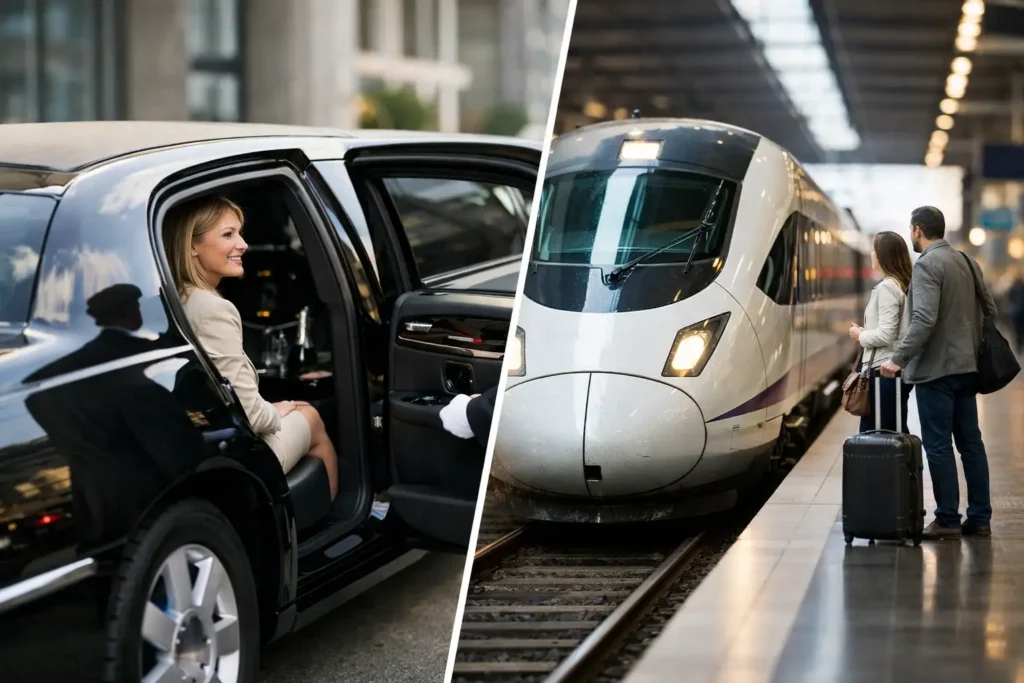
A 7:15 a.m. flight does not leave much room for a missed connection, a full platform, or a train delay that turns a simple airport run into a scramble. When comparing limo versus train travel, the real question is not which option is better in every situation. It is which one gives you the right level of control for the trip in front of you.
Train travel can be efficient for certain downtown routes and solo travelers who are comfortable moving through stations. A pre-booked limo is built for the moments when timing, luggage, family coordination, or a professional arrival cannot be left to chance. Here is how to make the call with confidence.
Limo Versus Train Travel: The Difference Is Control
A train runs on a public schedule. That can be useful when the station is close, service is frequent, and your destination is within easy walking distance of the last stop. You pay for a seat and follow the route already in place.
A chauffeur-driven car service works around your schedule. Your vehicle arrives at your requested pickup point, carries your luggage, and takes you directly to the terminal, hotel, office, or home. There is no station transfer, no search for a rideshare pickup area, and no need to bring a tired child, a garment bag, or three suitcases up and down stairs.
For airport travel, that distinction matters. The trip is rarely just the time spent moving. It includes getting to the station, waiting for the train, finding space for bags, leaving the station, and completing the final leg to the terminal or destination. A direct car service reduces those handoffs.
When Train Travel Is the Practical Choice
Train travel has a clear place in a smart travel plan. If you are traveling alone with a backpack or one small carry-on, starting near a station, and heading to a central destination, it may be the simplest option. It can also be a good fit when you have a flexible schedule and do not mind building extra time into your day.
Trains are particularly useful for travelers who prefer not to drive or navigate city traffic themselves. On a predictable route, you can sit down, read, answer messages, or simply avoid parking concerns. For some commuters, the familiar routine is part of the appeal.
The trade-off is that train service follows its own timetable, not yours. If your flight lands late, you may need to work around reduced evening service. If you are traveling during peak periods, finding room for luggage and a comfortable seat can be less certain. And if your destination is not close to the station, the trip still requires another vehicle, another wait, and another fare.
When a Limo Service Makes More Sense
A limo service is not only for formal events or special occasions. It is a practical choice when the cost of being late, uncomfortable, or overloaded is higher than the savings of a public route.
For an airport departure, a pre-booked car gives you a defined pickup time and a direct route to the terminal. Professional chauffeurs understand airport access, terminal approaches, and the value of arriving with enough time to check bags and clear security without rushing. For arrivals, flight tracking and pickup updates help remove the uncertainty that often follows a delayed or early flight.
This is especially valuable for travelers leaving from Toronto, Markham, Ajax, or Pickering for Pearson Airport. A station-based trip can involve multiple connections before you even reach the airport. A private transfer starts at your door and ends where you need to be.
A limo is also the stronger option when you are carrying more than a small bag. Airport luggage, golf clubs, strollers, work equipment, presentation materials, and winter coats can make public transit feel much longer than it looks on a map. The right sedan, SUV, or van gives each passenger room to travel without balancing bags in an aisle or worrying about storage space.
For Families and Groups, Compare the Total Trip
A train fare can look less expensive at first glance. But a family or group should compare the full cost and effort, not just the price of one ticket. Add multiple fares, station parking, local transfers, and the practical challenge of keeping everyone and every bag together.
A private vehicle can be easier to coordinate, particularly for early-morning departures and late-night arrivals. Everyone leaves from the same place, travels together, and arrives together. Parents do not need to manage children through crowded platforms. Group members do not need to decide who will handle the final transfer from the station.
For four or more passengers, a properly sized SUV or van can be a more sensible arrangement than separate tickets and separate connections. The best choice depends on the route and group size, but direct service often delivers more value than travelers expect.
For Business Travel, Time Is More Than Minutes
Business travelers often judge transportation by whether it protects the day. A late arrival at a client meeting, a missed flight, or an unreliable pickup can affect more than an itinerary.
Train travel may work for a routine commute between stations. But it can be less suitable when you are carrying a laptop bag and presentation materials, arriving from an overnight flight, or heading to a meeting where a polished arrival matters. A chauffeur-driven car provides a quiet, private environment from pickup to drop-off. You can make a call, review notes, or simply reset before walking into the next commitment.
Fixed pricing also helps with planning. You know the transportation cost before the ride begins instead of watching a fare change due to demand, route changes, or a last-minute alternative. For corporate travelers and executive assistants, that clarity is part of reliable trip management.
Comfort, Privacy, and Safety Are Not Extras
A train is shared transportation. That is its purpose. You share the space, stops, noise level, and boarding process with other riders. On many trips, that is perfectly acceptable.
A private limo service provides a controlled environment. The vehicle is reserved for your party, the chauffeur is assigned to your booking, and the route is planned around your pickup and destination. Licensed and insured chauffeurs, clean vehicles, and professional service standards matter most when you are traveling with family, clients, or valuables.
There is also a difference between being transported and being looked after. A reliable service confirms the booking, communicates pickup details, and monitors flight information when airport timing changes. Those details eliminate the common pain points travelers remember: standing on a curb, wondering if the driver is coming, or trying to rearrange transportation after landing.
Questions to Ask Before You Choose
Before deciding between a train and a limo, look beyond the route. Ask whether you need to arrive at a specific time, whether your flight schedule leaves room for delays, and how much luggage you will have. Consider the first and last mile of the trip, not only the time on the train.
Also consider who is traveling with you. A solo passenger with a light bag has different needs than a family of five, an executive team, or a couple heading out for a special trip. Weather is another practical factor. A direct, door-to-door ride is far more appealing when heavy rain, snow, or extreme temperatures are part of the forecast.
Finally, decide how much uncertainty you are willing to manage. If you are comfortable adapting to schedules, walking between connections, and allowing extra time, a train can serve you well. If the trip needs to run on your schedule, a reserved private car is the more dependable choice.
For travel that cannot afford a shaky start or finish, choose the option that removes the most variables. A confirmed pickup, a vehicle sized for your party, and a direct route let you focus on the flight, meeting, or occasion ahead instead of the transportation around it.