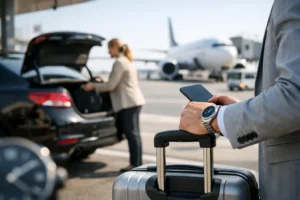

A store associate brings your order to your car. An airport driver meets you outside the terminal. Both are often called curbside pickup, but the experience, rules, and level of planning can be very different. So, what is curbside pickup? At its simplest, it is a handoff at or near the curb that lets you avoid going inside.
For busy travelers, families, and professionals, the appeal is obvious: less walking, less waiting, and fewer moving parts. But curbside service only works well when everyone knows where to go, when to arrive, and what the location allows.
What Is Curbside Pickup?
Curbside pickup is a service where a business prepares an item, order, or passenger pickup in advance and completes the exchange outside, usually at a designated curbside area or parking space. Instead of entering a store, restaurant, or terminal, the customer checks in by phone, text, app, or a posted instruction and waits in their vehicle or at the agreed meeting point.
In retail, this usually means ordering online, receiving a notification that the order is ready, and parking in a marked pickup space. A staff member verifies the order and places the items in the vehicle.
In transportation, curbside pickup can mean a driver collecting a passenger outside a terminal, hotel, office, venue, or residence. The passenger and driver need a clear meeting point, accurate timing, and a practical way to communicate if traffic, baggage, or terminal congestion causes a delay.
The shared idea is convenience. The difference is that a missed grocery pickup is frustrating, while a missed airport pickup can affect a flight, a business meeting, or a family’s travel plans.
How Curbside Pickup Works
The process is usually straightforward, though each business sets its own rules. You place an order or reserve a service in advance, receive instructions, arrive at the designated area, and check in. The business then brings the order out or sends the driver to the approved pickup point.
For retail and restaurant orders, curbside pickup is often available within a defined time window. You may be asked for your parking space number, vehicle color, or order number. The business may bring the order to your trunk or passenger-side door.
For passenger transportation, the sequence should be more precise. A pre-booked car service confirms the reservation details, tracks the flight when applicable, and communicates the pickup instructions. Once the passenger has collected luggage and is ready to exit, the driver proceeds to the appropriate terminal curb or designated commercial vehicle area.
That timing matters. Airports do not function like ordinary parking lots. Drivers often cannot wait at the curb for long, and passengers may be directed to specific zones based on the terminal, vehicle type, or local airport rules.
Curbside Pickup at Airports Is Different
Airport curbside pickup sounds simple until you are standing outside a busy terminal with luggage, children, a delayed flight, and multiple lanes of traffic. The curb is a controlled space, not a place where vehicles can sit indefinitely while passengers search for one another.
At many airports, private vehicles and commercial transportation providers have separate areas. Some airports require drivers to wait in a staging lot until the passenger is ready. Others assign pickup zones by terminal door, ground transportation category, or lane. These procedures can change during construction, peak travel periods, or security events.
A reliable airport pickup plan accounts for these conditions before the passenger lands. That means using the correct flight number, providing a reachable mobile number, and knowing whether the driver will meet you curbside or inside the terminal. It also means understanding that the safest choice is not always the closest lane to the exit door.
For example, a chauffeur may need to circle the terminal or wait in an authorized holding area until you confirm that you have your bags. That is not poor service. It is often the only way to follow airport traffic rules while avoiding an illegal stop or last-minute confusion.
Curbside Pickup vs. Meet-and-Greet Service
Curbside pickup and meet-and-greet service are related, but they are not interchangeable.
With curbside pickup, you leave the terminal and meet the vehicle at an assigned outdoor location. It is usually the faster option when you are traveling light, know the terminal layout, and can receive text updates. You avoid the extra time of locating someone inside the building, but you may need to manage luggage carts, crowds, and weather on your own until you reach the car.
With a meet-and-greet service, a chauffeur or representative meets you inside the terminal, often near baggage claim or a designated arrivals area. This can be especially useful for first-time visitors, families with young children, older passengers, travelers with substantial luggage, or executives arriving on a tight schedule. The trade-off is that indoor meet-and-greet arrangements may cost more and must comply with the airport’s access rules.
The right choice depends on the airport, your group size, your luggage, and how much guidance you want after landing. If your priority is a quick exit, curbside may be ideal. If your priority is assistance and certainty inside an unfamiliar terminal, meet-and-greet may be worth arranging.
When Curbside Pickup Makes Sense
Curbside pickup is most useful when the handoff is simple and timing is predictable. It works well for travelers who have confirmed their arrival details, can communicate by text, and are comfortable following pickup instructions.
It is also a strong option for a planned airport departure. A chauffeur arrives at your home, hotel, or office at the scheduled time, helps with luggage, and takes you directly to the terminal. There is no need to search for parking, walk through a garage, or ask someone to circle the departures area.
For arrivals, curbside pickup is practical when you are ready to leave shortly after collecting baggage. Travelers with carry-on luggage can often move quickly. Those waiting for oversized bags, traveling with pets, or clearing customs after an international flight may need more flexibility.
In those situations, pre-booked transportation has an advantage over an on-demand ride request. A scheduled provider has your flight details, vehicle requirements, and destination in advance. At Airline Limo Pearson, that preparation includes flight-aware pickup planning, direct communication, and a vehicle selected for the number of passengers and bags – not a guess made after you land.
How to Make Airport Curbside Pickup Go Smoothly
A smooth pickup begins before departure. Share your flight number rather than only your arrival time, since schedules can change. Make sure your phone is charged and able to receive calls or SMS messages after landing. If you are traveling internationally, confirm your phone plan or connect to airport Wi-Fi before you leave the terminal.
Be specific about your group and luggage. Two people with two carry-ons have different transportation needs than four adults, a stroller, golf bags, and multiple checked suitcases. A sedan may be comfortable for one trip and impractical for the other. Choosing the right vehicle in advance prevents awkward loading decisions at a crowded curb.
Once you land, do not rush outside before you are actually ready. Collect your bags, confirm your pickup instructions, and let the driver know when you are approaching the exit. Then follow the terminal and zone details exactly. “Outside arrivals” may not be enough information at a major airport with several doors and traffic lanes.
If plans change, communicate early. A delayed bag, a missed connection, or a change in passenger count is easier to manage before the driver reaches the terminal curb. Clear updates protect your time and help the driver avoid unnecessary loops through congested airport roadways.
Common Curbside Pickup Problems to Avoid
The most common problem is treating a curbside pickup like a parking arrangement. At airports, a driver may be asked to move along within seconds. If the passenger is not ready, both people can end up frustrated and harder to reconnect.
Another issue is vague communication. Saying “I am outside” does not identify a terminal, door number, level, or vehicle lane. A useful message includes the terminal, exit door or zone, and whether you have all your luggage.
Finally, do not assume every app-based ride or private driver can use the same pickup area. Airports often regulate commercial pickups, rideshare operations, and limousine services differently. Licensed providers that work regularly at the airport understand these rules and can give passengers realistic instructions instead of making promises that are impossible to keep at the curb.
The best curbside pickup feels uneventful: your order is ready, your driver knows where to be, and you know exactly where to stand. For airport travel, that kind of calm comes from planning the pickup before the wheels touch down.