A full-size suitcase standing in the hallway is easy to picture. Four of them, two carry-ons, a stroller, and four travelers headed to the airport is where planning matters. When travelers ask how much luggage fits SUV vehicles, the honest answer is that it depends on the number of passengers using the rear seats, the actual size of each bag, and whether a third row is needed.
For a private airport transfer, luggage capacity should never be a guess. A vehicle can look spacious from the curb yet become cramped once every seat is occupied. The right SUV gives your group room to sit comfortably, keeps bags secure, and avoids the awkward scramble of trying to force one more suitcase into the cargo area.
How Much Luggage Fits an SUV?
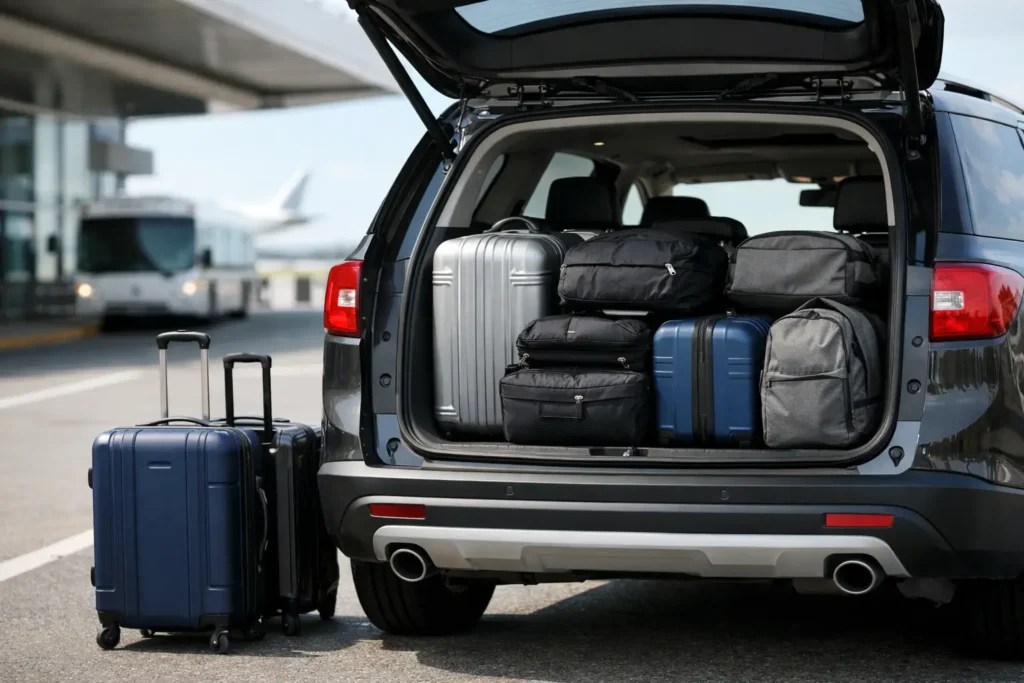
Most premium SUVs can handle a practical mix of checked bags and carry-ons, but capacity changes quickly as passenger count rises. A two-passenger airport ride usually leaves most of the rear cargo area available. A family of five using every seat has far less usable space, especially in a three-row model.
The estimates below assume standard large checked suitcases, not oversized sports equipment, extra-large hard cases, or bulky cartons.
| Travelers | Typical SUV luggage capacity | |—|—| | 1-2 passengers | 4-6 large checked bags, plus carry-ons | | 3 passengers | 3-5 large checked bags, plus a few carry-ons | | 4 passengers | 3-4 large checked bags, depending on bag shape | | 5-6 passengers | 1-3 large checked bags when the third row is in use |
These are planning ranges, not a promise that every bag will fit. A soft duffel can tuck into spaces where a rigid suitcase cannot. On the other hand, a 29-inch hard-shell case takes considerably more room than a standard carry-on. Two travelers with golf bags may need more cargo capacity than four travelers with compact luggage.
Why the third row changes everything
Three-row SUVs are excellent for moving more people, but the open cargo space behind the third row is limited. When all rear seats are upright, there may be enough room for a couple of large bags and smaller personal items, not a full family’s vacation luggage.
If the third row can be folded down, cargo capacity expands significantly. That setup works well for three or four passengers traveling with several checked bags. It does not work when six passengers each need a seat. This is the detail that causes most airport transportation surprises: passenger capacity and luggage capacity are not the same thing.
Bag Size Matters More Than Bag Count
“Four bags” can mean four carry-ons or four oversized cases. Those are completely different loads. Before reserving an SUV, think about the bags as they will actually appear at your front door or hotel lobby.
A standard checked suitcase is usually easier to load than a large garment bag, a child’s wagon-style stroller, a ski bag, or a musical instrument case. Baby gear also deserves special attention. A travel stroller may fit easily, while a full-size stroller with a car seat can take the space of one or two checked bags.
For business travelers, the calculation is often simple: one checked suitcase, one carry-on, and a briefcase per person. For a family leaving Toronto for a longer trip, it is more likely to include several large suitcases, backpacks, a stroller, and snacks or travel supplies. The vehicle should be selected for the second scenario, not the first.
Common Airport Trip Scenarios
A couple heading to Pearson Airport with two large suitcases and two carry-ons will usually travel comfortably in an SUV. There is room for the bags without placing anything in the passenger area, and the rear seats remain available if needed.
Three colleagues traveling for a conference may have one checked bag and one carry-on each. This can fit in many SUVs, but it is wise to identify the number of checked bags at booking. If every traveler has a large case, an executive van may offer a more relaxed ride and easier loading.
A family of four presents more variation. Two adults and two children with four checked suitcases, carry-ons, and a stroller may fit in a large SUV if the vehicle has adequate rear cargo space. Add a car seat, winter coats, or a second stroller, and a van becomes the more sensible choice.
Groups of five or six often assume an SUV is the obvious answer because it has enough seats. That is only half the question. If all six seats are occupied and everyone is checking a bag, a passenger van is generally the safer option. It provides room for people and luggage without compromising comfort or blocking the driver’s view.
When an SUV Is the Right Choice
An SUV is a strong choice for airport travelers who want a comfortable, private ride without booking a larger vehicle than necessary. It works especially well for couples, small families, executives, and groups of up to four with normal travel luggage.
It also offers practical advantages in winter weather and on longer regional trips. The raised seating position, comfortable cabin, and enclosed cargo area make it a dependable option for travel between the GTA, Pearson Airport, Hamilton, or other Southern Ontario destinations.
However, choosing an SUV solely because it seats six or seven people can create a cramped departure. If your group has more than four travelers with checked luggage, or any oversized items, reserve a larger vehicle. The extra space is not an indulgence. It is what keeps the pickup organized and the ride comfortable.
How to Book the Right Vehicle the First Time
The most useful booking information is specific. Rather than saying “we have luggage,” provide the number of passengers and describe what you are bringing. A professional chauffeur service can recommend the appropriate vehicle before pickup day, when there is still time to plan properly.
Include these details with your reservation:
- The total number of passengers, including children who need seats
- The number of checked suitcases, carry-ons, and personal bags
- Any oversized items such as strollers, golf clubs, skis, wheelchairs, or garment bags
- Whether a child seat or additional passenger pickup is required
Photos are not usually necessary, but clear descriptions help. Saying “three 28-inch hard-shell suitcases, two carry-ons, and a compact stroller” gives a far better picture than saying “a few bags.” It lets the transportation provider assign a vehicle based on the load, not assumptions.
At Airline Limo Pearson, this kind of advance planning supports a controlled airport experience: the proper vehicle arrives, the chauffeur has the trip details, and your group is not left rearranging bags on the curb. It is particularly valuable for early flights, families traveling during school breaks, and business travelers who cannot afford a late or disorganized pickup.
Do Not Plan to Hold Luggage in the Cabin
A carry-on purse or small backpack is one thing. Large suitcases in the passenger cabin are another. They reduce legroom, can interfere with entry and exit, and may shift during the ride. For airport transfers, luggage should be properly secured in the cargo area whenever possible.
If the expected bags leave no comfortable room for passengers, the answer is not to squeeze everyone in. Book a larger vehicle. You will have a cleaner pickup, an easier load-out at the terminal, and a far better start to the trip.
The best airport ride is the one that feels straightforward from the moment the chauffeur arrives. Count every passenger, measure luggage by size rather than optimism, and reserve enough space to travel without last-minute surprises.