
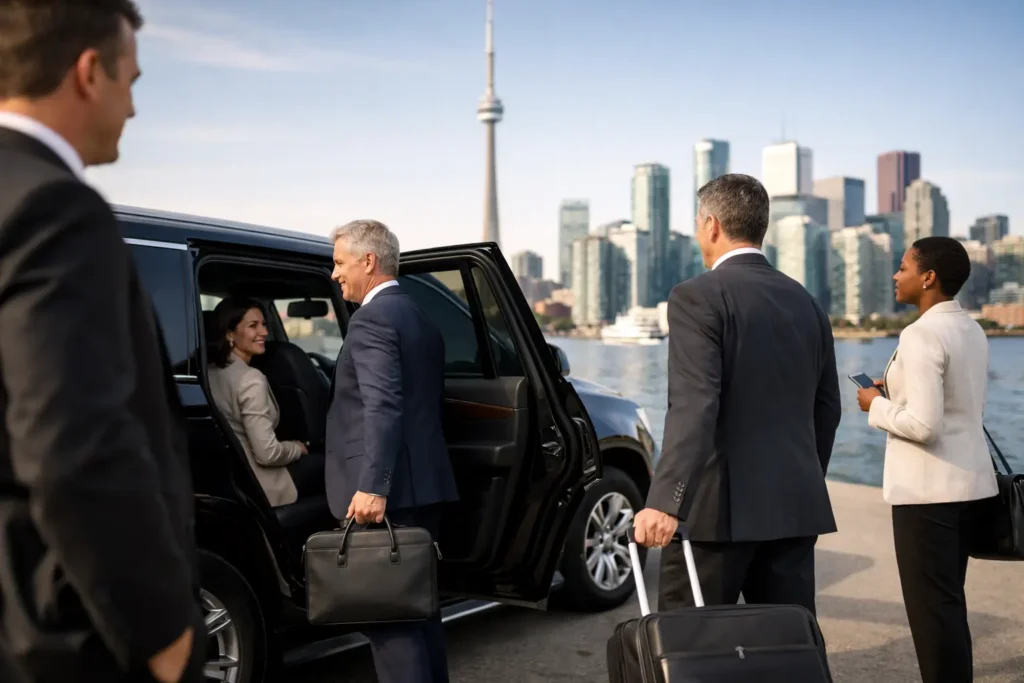
A six-hour roadshow can fail before the first meeting begins. One delayed pickup, a driver who cannot find the correct entrance, or an SUV without room for presentation cases can put senior leaders on the defensive all day. This executive roadshow transport example shows how a properly planned chauffeured service protects the schedule, the team’s energy, and the client experience.
A roadshow is not a typical point-to-point ride. It is a moving business day with fixed meeting windows, changing traffic conditions, confidential conversations, luggage or equipment, and little tolerance for uncertainty. The transportation plan has to account for all of it before the first vehicle arrives.
Executive Roadshow Transport Example: A One-Day Schedule
Consider a Toronto-based investment team hosting two visiting executives and an analyst. Their day includes an early arrival at Pearson Airport, four meetings across downtown Toronto and Markham, a working lunch, and an evening departure from Pearson. They need space for carry-on luggage, garment bags, laptops, and printed presentation materials.
The itinerary looks manageable on paper:
- 8:10 a.m.: Meet arriving executives at Pearson Airport
- 9:30 a.m.: First meeting in the Financial District
- 11:15 a.m.: Client presentation near Yorkville
- 1:00 p.m.: Working lunch in North York
- 3:15 p.m.: Final meeting in Markham
- 5:30 p.m.: Return to Pearson Airport for an 8:15 p.m. flight
A rideshare booking for each leg may appear less expensive at first. But it creates a new pickup, a new driver, uncertain vehicle capacity, and a fresh opportunity for delay every time the group changes locations. That is a poor fit for a day where the executives need to be prepared, present, and on time.
The better choice is a dedicated executive SUV or van with one professional chauffeur assigned for the full roadshow. The vehicle remains available between meetings. The chauffeur knows the group, the route plan, the luggage requirements, and the next destination before each meeting ends.
Start With the Schedule, Not the Vehicle
The vehicle matters, but the itinerary drives the service plan. Before confirming transportation, the coordinator should provide flight details, meeting addresses, primary contacts, expected passenger count, luggage volume, and the order of stops. If a meeting has a strict arrival time, that should be clearly identified.
For this example, the chauffeur is dispatched early and monitors the incoming flight. If the plane lands ahead of schedule or is delayed, the airport pickup adjusts without the traveler needing to stand at the curb and search for a car. Clear SMS updates give the arriving team a direct point of contact and pickup instructions.
At Pearson, terminal familiarity is not a minor detail. A chauffeur who understands airport procedures, approved pickup areas, and traffic flow can prevent the awkward calls and long walks that often follow an airport arrival. For visiting executives, that first handoff sets the tone for the entire day.
The roadshow coordinator should also build in reasonable buffers. A 9:30 a.m. meeting does not mean planning to pull up at 9:29. The team may need ten minutes to gather materials, check messages, or enter a building with security procedures. The goal is to arrive early enough to be composed, not merely technically on time.
Why a Dedicated Chauffeur Changes the Day
The strongest roadshow plans remove repeated decisions. The team should not have to compare ride options, wonder whether a driver will cancel, or split into separate cars because the vehicle that arrived is too small. A dedicated chauffeur turns transportation into a controlled part of the schedule.
Between the Financial District and Yorkville, the executives can review notes, make private calls, or prepare for the next presentation. After the North York lunch, the driver can select the most practical route toward Markham based on current conditions and the required arrival time. The passengers do not need to manage navigation while trying to manage a business agenda.
There is also a professional advantage in keeping the same vehicle and chauffeur throughout the day. The driver learns where the group prefers to be dropped off, how much time they need to exit, and when a quiet ride is more useful than conversation. The service becomes consistent instead of transactional.
For high-level meetings, privacy matters too. A private chauffeured vehicle offers a more appropriate setting for sensitive discussions than a shared shuttle or a series of unfamiliar rideshare cars. That does not mean a car becomes a boardroom. It means the team has a clean, quiet, dependable place to regroup between appointments.
Vehicle Choice Depends on People and Materials
A luxury sedan can be ideal for one or two executives with light luggage. It is not the right answer for three passengers carrying airport bags, sample materials, and winter outerwear. For this roadshow, an executive SUV is the sensible choice because it provides passenger comfort and practical cargo capacity without separating the group.
A larger van may be the better option when the roadshow includes six or more attendees, a production crew, display materials, or multiple airport arrivals. The trade-off is simple: larger vehicles offer more capacity, but they may be less convenient at tight downtown entrances or hotel driveways. The transportation provider should assess the actual stops rather than automatically sending the largest vehicle available.
Vehicle condition also affects the experience. Clean interiors, working climate control, charging access where available, and enough room to sit comfortably are practical requirements on a full day of travel. When clients or senior guests are involved, these details reflect on the company that arranged the transportation.
Plan for the Parts That Change
A roadshow schedule is often precise until it is not. A meeting runs long. A client asks for an unscheduled stop. Weather slows traffic. An executive changes flights. The right response is not to promise that nothing will change. It is to have a service structure that can respond without creating chaos.
In this example, the coordinator gives the chauffeur one direct contact for updates and confirms whether the vehicle should wait nearby or remain at the entrance during each appointment. That distinction matters. In dense downtown areas, waiting at the curb may not be possible. In business parks or suburban offices, staying on site may be the most efficient option.
The chauffeur should receive updated timing as soon as the team knows a meeting is running over. Early communication gives the driver time to adjust the route, staging location, and airport return plan. Waiting until the group is already outside creates avoidable pressure.
Fixed, pre-arranged pricing is equally useful when the day is high stakes. A coordinator should know the service terms in advance rather than trying to reconcile unpredictable surge pricing or multiple receipts after the roadshow. The value is not simply administrative. It allows the team to focus on the meetings that justify the trip.
The Airport Return Is Still a Business-Critical Leg
The final ride to Pearson is often treated as an afterthought, even though it carries the highest consequence. Missing a flight can lead to rebookings, overnight stays, lost work time, and a difficult end to an otherwise productive day.
For an 8:15 p.m. departure, the return pickup should reflect the terminal, airline, expected traffic, checked baggage needs, and the group’s preferred airport arrival time. If the final Markham meeting could run over, the plan should include enough buffer to protect the flight without forcing the executives to leave too early.
The same chauffeur who handled the day already knows the passenger count, luggage load, and flight details. There is no need to start from zero with an unfamiliar driver during the most time-sensitive trip of the schedule.
What a Roadshow Coordinator Should Confirm
A roadshow runs best when the transportation provider receives one complete, written itinerary rather than scattered messages. Confirm each pickup address, meeting location, airport flight number, passenger names, mobile contact, vehicle preference, and special requirements such as extra luggage or mobility needs.
Also identify the person authorized to make day-of changes. When several people send separate instructions, a simple adjustment can become confusing. One point of contact protects the plan and helps the chauffeur act quickly when timing changes.
Airline Limo Pearson supports this kind of pre-booked, chauffeur-driven coordination for airport and business transportation across Toronto, Pickering, Ajax, and Markham. The focus is straightforward: licensed, insured chauffeurs, clear communication, appropriate vehicle options, and no last-minute scramble for a ride.
A successful roadshow should leave executives thinking about the meeting they just had and the one ahead, not the vehicle outside. Build the transportation plan with the same care as the presentation agenda, and every stop has a better chance of starting on the right foot.